All posts by chris

Building a Mini-Golf Hole Session

It’s still not too late to put together a mini-golf hole for Putt Putnam County. This Saturday from 9 am to noon, during Open Shop hours at Castlemakers, we’ll be building a mini-golf hole from scratch. We may even be able to help you build one for yourself/group/business for showing off at the main event on October 4th.

It’s a great way to see how quickly one can come together – we’ve built them before in less than 2 hours! But of course you can always overengineer things…

Sharing the Knowledge

A big part of our mission involves education and enabling people to learn and do things they didn’t realize they could do. That’s why we offer classes and workshops to others.

Fusion 360 Class at Castlemakers
Sam W. goes over designing parts in Fusion 360.

It’s also about sharing knowledge with others. Being an all volunteer organization, we rely on not only our active members to share that knowledge but also others in the community. So when a CNC machinist who works in Terre Haute volunteered to teach a class in the software program he uses everyday, Fusion 360, we jumped at the opportunity. It turned out to be a great hands-on class on how to design parts and components in 3D – he offered to help the class attendees on their own design in the last hour of the class.

Do you have something you’d be willing or like to show others in our community? We’re glad to work with you put together a workshop or class, it’s something that we have done a lot over the last 10 years since Castlemakers first started as a ‘maker group’ and later turned into a makerspace. We’ve offered classes from Artificial Intelligence (AI) to Welding – and an awful lot in between. Stop in during our Open Shop times or send us an email if you have something you’d like to share!

Putt Putnam Planning for 2024

Guidelines for Putt Putnam County have been updated and already some folks are planning new/improved mini-golf holes for our annual mini-golf hole event in October. Of course there will be lots of us last minute builders, but still it’s not too early to start thinking about building a mini-golf hole for the event!

Putt Putnam County
A sudden cold front knocked down signs in 2023, but a determined young man continues to play through.

As a refresher, for the last 7 years we’ve hosted an annual ‘build a mini-golf hole’ community event that continues to grow. Last year we had 13 different mini-golf holes lined down Franklin Street in downtown Greencastle to play free mini-golf on a Friday night. The holes are built by people in the community & Castlemakers members – it’s open for anyone to build and show off their creation in this annual family oriented event. We’ll even help you if you need ideas or help turning your own idea into a built creation. It’s a great group or family project to bring out and show off to others!

And of course don’t forget to join us on Friday October 4th from 6 to 8:30 pm on Franklin Street in Downtown Greencastle to checkout the creations and play a few rounds of mini-golf!

2024 Field Day

Several us here at the makerspace have amateur radio licenses and like to help with that community also. This year at Field Day we did another educational session at the event organized by PCAuxCom, a local amateur radio group.

Chris(N9VFD) shows Zach (KD9HIG) how to transmit a phone SSTV image.

We decided to give a presentation on SSTV and how it can be used with phone or tablet app to send pictures using an amateur radio – no network connection or cell phone coverage needed! We started using SSTV here at the makerspace to see the occasional transmitted pictures from the International Space Station(ISS) when it passes overhead. Later we discovered the cell phone/tablet apps for SSTV reception and transmission – then realized it would be easy to hold a handheld radio up to the device and transmit images that way.

If you’d like to read more, I’ve created a webpage that describes how it works and includes the presentation made that day. We’re also experimenting with an interface to connect a cell phone or tablet directly to an amateur radio, will update the webpage or stop by the makerspace if you’re interested.

Artificial Intelligence / LLM Workshop

Making an AI LLM Workshop
Ian covers how to make an AI LLM on a local PC.

We held our first Artificial Intelligence (AI) / local Large Language Model (LLM) workshop at Castlemakers last Thursday. The focus was on downloading & creating an AI LLM local model using Ollama on a Windows PC, but given the target audience (those unfamiliar with AI) we used a ‘docker’ to keep it simple and spent a lot of time explaining all of the terms involved.

Discussion around using AI LLMs
Attendees discuss what’s involved in a LLM.

We decided to try a more cutting edge topic to expose people to AI and open source LLMs – plus help people realize it’s not as hard to do as it might seem. Having someone in our midst, Ian, that has been trying and using the different models also really helped! Folks attending had an option to take home a USB drive loaded with the software to install and try the software on their local computer at home.

If you’re interested in the topic, stop by Castlemakers during our Open Shop hours – we still have the system installed on a surprisingly small computer and with the Ollama interface you can try different open source LLM models on a local pc. It’s a great way to learn and experiment with something that will be effecting all of us already and in the coming future…

First Friday Season

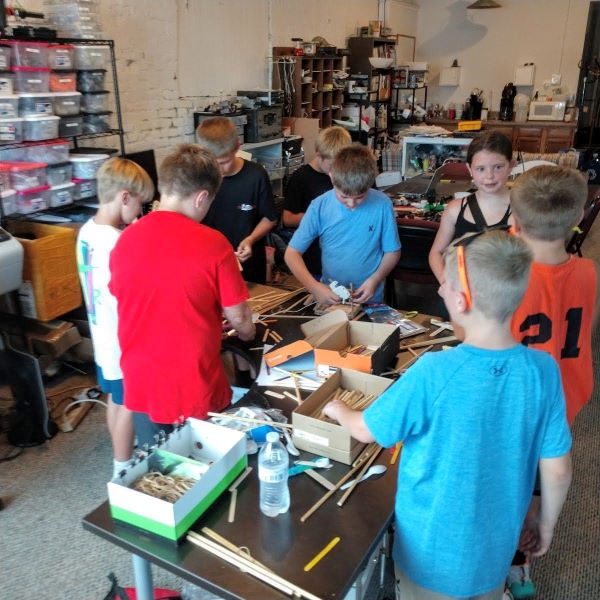
Building Catapults at Castlemakers during First Friday
There was lots of activity inside building catapults before going outside to hurl objects at a target.

One of the things we always look forward to in the summer and fall is Main Street Greencastle‘s First Friday. With our location in downtown Greencastle on Franklin Street, we have a great location to have a hands-on, youth-oriented, ‘making’ project outside for people attending the monthly event. It’s also an opportunity for folks to checkout the makerspace & some of the current projects – although Open Shop times are another time good for that too.

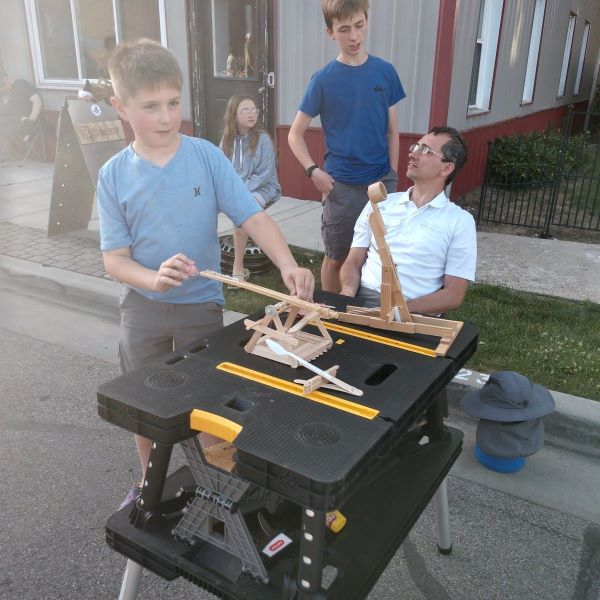
Testing a catapult
Getting ready to test launch a catapult.

Projects change each month, but June was one of my favorites – catapults, something we’ve done a lot of with youth over the years. Given the age span of First Friday visitors and the time typically spent, this time we had them build chopstick and popsicle stick catapults – although one youngster was there for 1.5 hours working on his!

Plans are in the works for July 5th First Friday, please stop by. And don’t forget our annual Putt Putnam County event, which will be held on Friday October 4th from 6-8:30 pm. Last year we had 13 mini-golf holes built by people in our community. It’s not to early to think about building a hole and we’re always glad to you build one!

AI Making

Not surprisingly given some of our member’s interest in software, there’s been a lot of discussion at Castlemakers about Artificial Intelligence(AI). We started experimenting with machine learning, an application of AI, several years ago in a squirrel proof bird feeder. And since two of our members work with software it’s been a hot topic during a lot of Open Shop times recently.

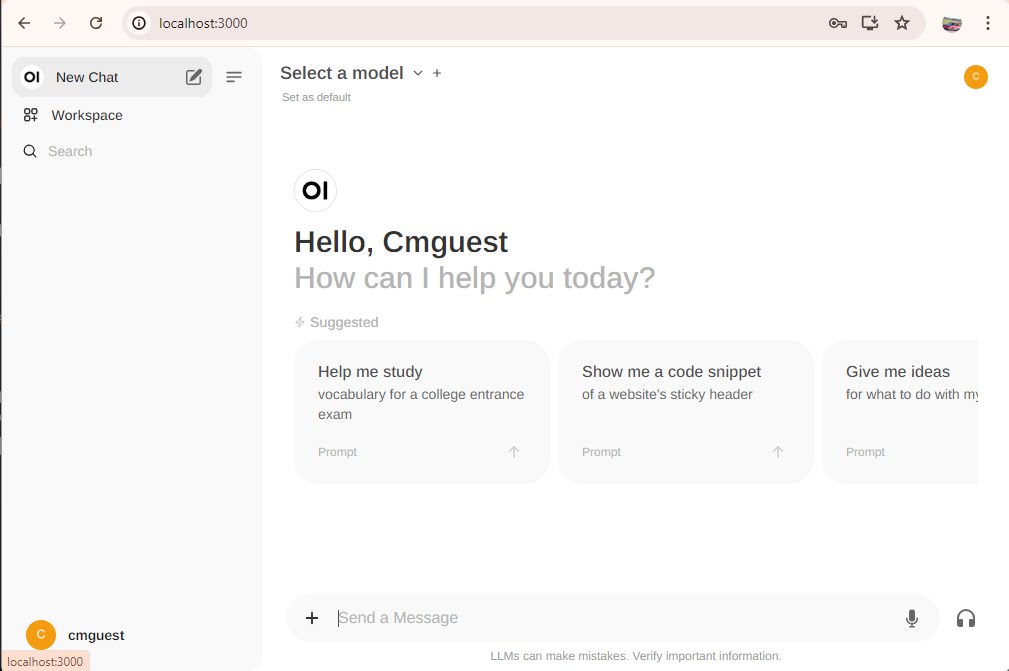
Screenshot of Ollama running TinyLlama on a local i5 Windows PC at Castlemakers to test local AI queries.

Many people don’t realize how rapidly using Large Language Models (LLM, but for that matter all AI) is becoming possible using smaller computers. One of the big changes has been open source software that provides installation capabilities and a front end for the LLM that you can run on a Windows/Linux/Mac machine.

Which has led into a workshop/class on the subject in June. It started as a way for more of us to learn about running an open source LLM on a workstation or laptop, but realized there might be more people that would like to find out more on how easy it is to set one up on a local computer. So June 20th at 7 pm we’ll be having a small class in using Ollama to install an open source LLM on a Windows PC – please check our Classes webpage for more information and to make reservations if you’re interested!

The Value of Prototyping

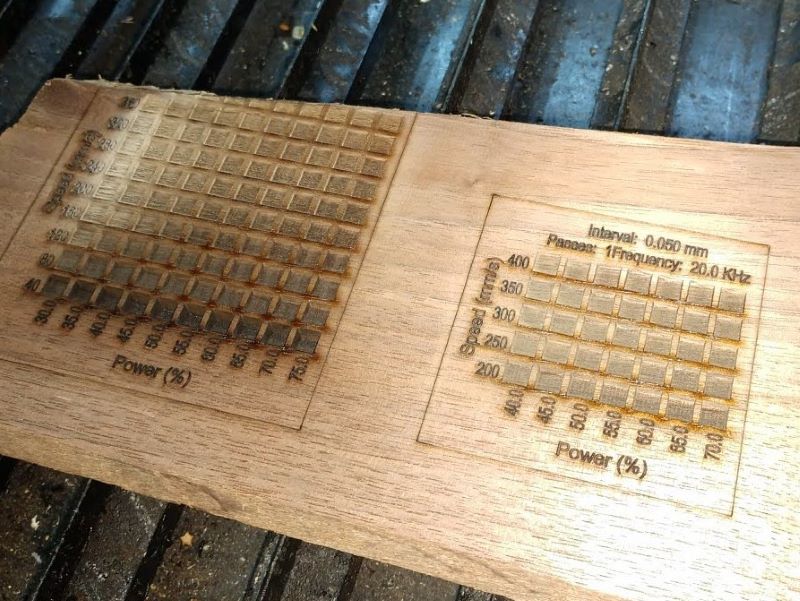
Power vs Speed grid to determine proper levels for the desired depth & darkness in black walnut wood.

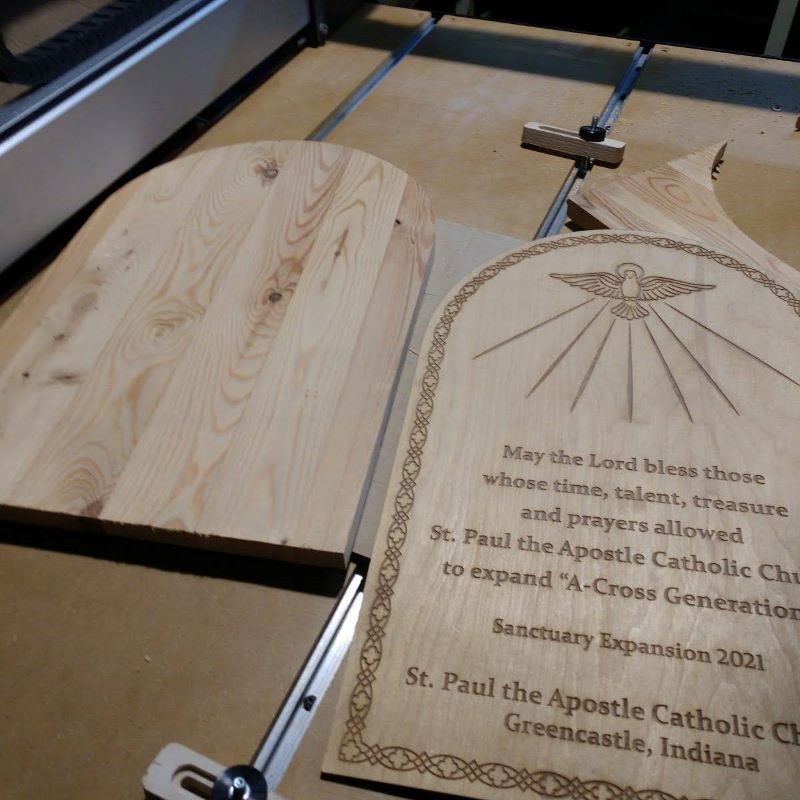
One of our members wanted to make a commemorative plaque for his church using the CNC and laser engraver at Castlemakers. I volunteered to help, thought it would be a good chance to use our bigger CNC with some newly updated software and we could both learn in the process.

CNC plaque cutout with the first prototyped laser engraving.
First engraved prototype in plywood next to a full thickness pine cut out on our CNC.

Given the nice wood they wanted to use, doing several prototypes with lower cost wood seemed in order. It also would give him something to show the church committee approving the plaque. Ed was able to locally source some rough cut black walnut wood and another member Ian used his planer so the wood could be glued to an appropriate width.

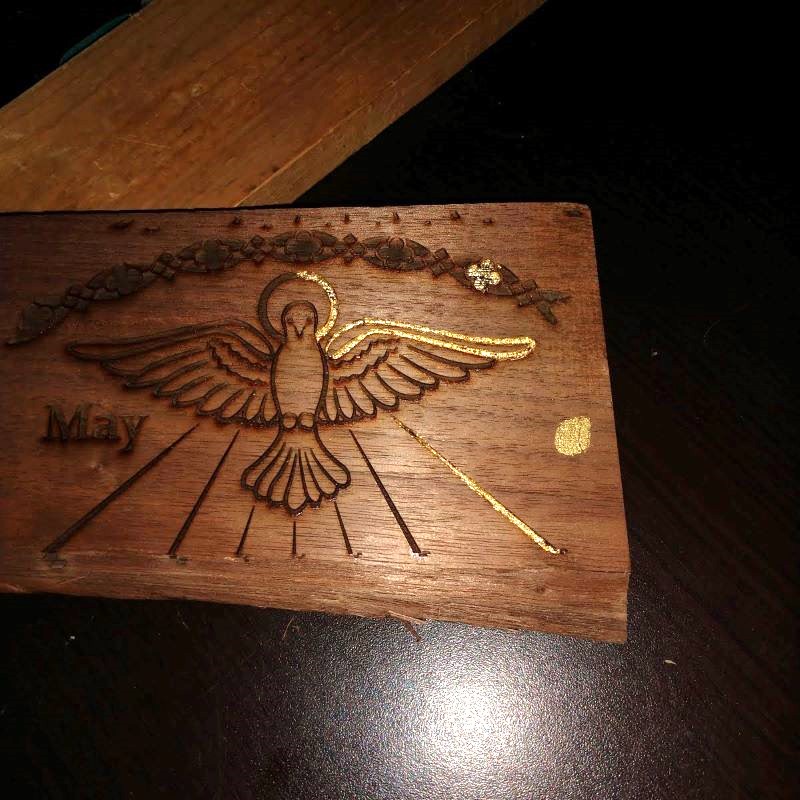
In the meantime one of the other church members created a great looking design for the engraving. For the first prototype, done in birch plywood, we just used the laser to cutting the shape to show others for approval. This resulted in a few minor changes and a decision by the group to add gilding to part of the dove and the rays on the plaque.

Black walnut test gilding before changes.

The final plaque is on darker wood, so we engraved a sample portion on some scrap black walnut and it’s a good thing we did! The original rays were too thin, making gilding extremely difficult. Now with the final design was completed, another prototype was made in pine the thickness of the final plaque to make sure the CNC portion of the project was going to work with the engraving.

Pictures by Radio

An amateur radio mode called Slow Scan TV (SSTV), given the speed of transmission, is really more about sending pictures than sending video. I’m guessing the name came from it’s similarity to how television video used to work.

SSTV picture of Castlemakers received using an app & ham radio.

I’ve used slow scan to receive images transmitted from the International Space Station as it passes overhead, which has been covered in a previous blog posting. At that time we recorded the transmitted ‘image’ using a voice recording app on a cell phone, emailed the image to a computer, and then used MMSTV to turn the recorded sound into an image. A more permanent/perhaps better setup would be using an interfacing cable to connect the radio directly to a PC with sound input.

Several months ago Ian stumbled across a simple phone app that decodes SSTV images, Robot36. It decodes the image directly on your phone, using the cell phone mic as input. After discovering a similar SSTV encoding app, SSTV Encoder, we realized we could send images directly to each other using our handheld amateur radios.

Closeup of our sign at night using a handheld radio to transmit the picture wirelessly.

Of course you should be able to use this setup with walkie talkies, FRS or even GMRS radios. We’ve used it over our local amateur radio repeater for even longer distances, and planning a demo with some of the other local amateur radio operators probably during Field Day in June.

We’ve started a webpage that explains SSTV and some of the software you can use to view it in more detail if you’re interested in trying it/learning more!

Squirrel Proof Birdfeeder Testing

One of the longer term projects I’ve been working on at the makerspace is a squirrel proof birdfeeder that uses machine learning to identify squirrels vs birds, then make a noise when those darn squirrels try to get a snack in the birdfeeder!

Squirrel proof bird feeder made using acrylic and 3D printed parts.
Bird feeder without the onboard ESP32-EYE camera housing, which will be mounted on the right side.

The project goes back a few years when I stumbled across a Google project to make a design using a Coral development board to accomplish the same thing. Since we had the equipment to make most of the components at the makerspace, except the development board, I started making one and looking into improving their idea.

First minor change was an error in the CAD files, which I’ve corrected on my GitHub. It also seemed like the board they chose was overkill, I had wondered about using a Raspberry Pi, but then Brian pointed out it might need a board with a better GPU. Ian mentioned the ESP32 board/chip could run TensorFlow Lite & might do the job. Cost of the ESP32 boards was appealing, so I started going down that path even though I didn’t know much about the subject at the time!

Squirrel Proof Bird Feeder test picture
ESP32-EYE image from the bird feeder. The onboard facial recognition software generated the yellow box.

I made was the birdfeeder housing and seed holder well over a year ago, which turned out quite nice. But the ESP-EYE housing got complicated between mounting locations, how to power the device, how to create the noise and lots of other distractions, so it got put aside a while ago until I could get back to it. Earlier this month, with some help from a student working at the makerspace, I started working on it again creating a prototype housing for the ESP-EYE v2.1 board in Fusion360 and restarting the work on the software.

It’s now at the point where it’s taking pictures and we’ve begun training the software to identify squirrels (cat pictures work pretty well). It still needs more work, and I’ve gotten other projects that need finishing first. But I’ll put a page on our website when more details are finished. Or stop by our makerspace & we can show you the progress in person!